Charlestown Hill
The British had 2,400 trained soldiers recently reinforced.
They were up against 1,600 former farmers, laborers, and craftsman mustered into a less-than-a-week-old Continental Army.
The British commander ordered a contingent up the hill.
In retrospect, this was an incredibly stupid move.
The Americans were low on ammunition and were ordered to save as much as possible.
“Don’t shoot until you see the whites of their eyes.”
Colonel William Prescott, Battle of Bunker Hill
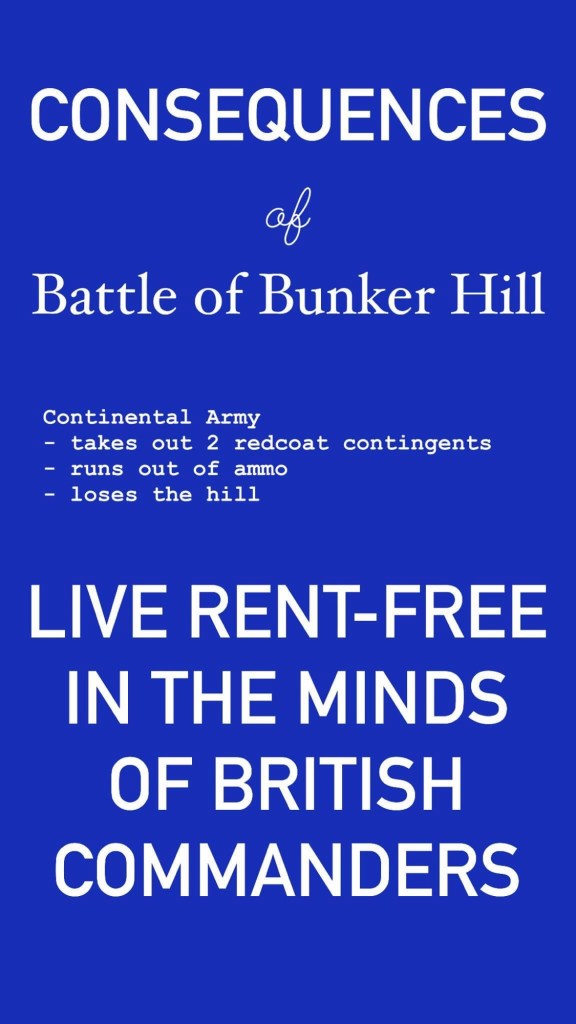
In less than an hour, the Americans mowed down the first contingent.
Believing in the utter inferiority of the Americans, and wanting to teach them a lesson, the British commander order a second contingent up the hill.
It experienced the same fate as the first.
Only the British commander’s sunk cost, ego, and motivated reasoning could explain the order to send a third contingent.
The third contingent survived because the Americans ran out of ammunition and fled.
The British technically won the Battle of Bunker Hill.
Pyrrhic Victory
Starting with 2,400 men, the British experienced a 45% casualty rate.
The 1,600 Americans suffered only a 28% casualty rate.
The redcoats had taken Bunker Hill, but the psychological cost was indelible.
After losing so many men, the original British commander was traumatized by the experience and was relieved of duty.
His replacement viewed the “civil war” against the Americans as stupid and immoral.
One theory was he never recovered from the bloodletting on Bunker Hill.
Sense of Victory
Despite having abandoned the Charlestown hill fortifications, the Americans felt as if they had won.
A lack of gunpowder had defeated them, not the British.
Commander George Washington took over Continental Army that was living rent-free in the minds of the British.
The British abandoned Boston 6 months later and would never return to control the territory of New England.